MetroHero is a semi-defunct real-time transit tracking and performance analysis application for the Washington Metro rapid transit system. Originally available on iOS, Android, and the web, it allows users to view live maps of all trains on a specific line, summary statistics relating to real-time system performance, and user feedback on current Metro conditions. The app launched in 2015, followed by ARIES for Transit, a related project from the same developers, and continued functioning until its original developers shut it down in 2023. Afterwards, forks of the application went live to allow for its continued public use, and the Washington Metropolitan Area Transit Authority (WMATA), Metro's operator, announced that it would launch a similar app. The app has been described by local news media as popular and well-liked among Washington, D.C.-area residents. == History and main development == MetroHero was initially developed by James and Jennifer Pizzurro, who both attended George Washington University and studied computer science. They said that they were inspired to create the app after experiencing train delays and searching for an app to track a train after boarding; such an app did not exist for the Washington Metro. The development of the app was not endorsed by WMATA, but it did use publicly available data from the agency. MetroHero launched as an Android application in September 2015, followed by the release of an iOS-compatible web app in December of that year. A standalone iOS app launched in April 2018, but the web app remained supported. By April 2018, MetroHero had approximately 13,000 monthly active users. James Pizzurro has stated that the app's intended audience was regular Metro commuters who wanted to communicate with each other about active problems, as opposed to tourists and riders who only wanted train time data. Throughout the application's development, the Pizzurros had been advocates for Metro's transparency with riders and the community by providing more high-quality data and taking on the feedback of developers. In particular, they criticized Metro's reluctance to uniquely identify individual train trips and its decision to obscure data under certain circumstances, which have posed problems for MetroHero's data collection. In addition to their work on MetroHero, the app's developers led or participated in other initiatives related to transit in the Greater Washington area. In 2019, MetroHero partnered with a local transit group to analyze Metrobus data and publish a "Metrobus Report Card", along with proposed goals and recommendations based on the report's findings. Based on this experience, MetroHero's developers began a sister project, the Adherence + Reliability + Integrity Evaluation System for Transit (ARIES for Transit), which displays data and issues grades for Washington- and Baltimore-area transit systems. Separately, James Pizzurro used MetroHero data to inform Rail Transit OPS, an independent Metro oversight group, and assist in its documentation of Metro system incidents. == Application == The MetroHero application uses several interfaces, including an overall dashboard and a live map, to display data to its users. On the dashboard, system-wide train summary data, such as the number of operating trains and headway adherence, is visible. The map offers a visual representation of all trains' positions throughout the system, filtered by line. Individual stations and trains can be selected to see ratings and comments provided by other users, including both positive and negative notes like cleanliness and crowdedness. Additionally, a list of train wait times is given, along with aggregate data like average wait time. Any train delays or service incidents are visible in the app. MetroHero uses several data sources for the various components of its application. Train positions and other operational data are provided by WMATA as part of its initiative to release open data for third-party developers. However, MetroHero's developers noted that the Metro-provided information is sometimes inaccurate and incomplete, thereby limiting the accuracy of MetroHero. The app also collects crowdsourced data from its users, who can report conditions in train cars and stations and add to reports sent by other people. Additionally, MetroHero parses data from Twitter feeds to learn about system incidents, including delays and fires. In addition to the web app, Android app, and iOS app, MetroHero's initial developers maintained automated social media accounts that alerted customers about Metro service; these accounts were discontinued upon the original app's eventual shutdown. MetroHero also hosts archived performance data for later review, a feature that is sometimes used after major incidents. == Shutdown and future == In February 2023, James Pizzurro announced that MetroHero would be shut down on July 1, 2023, citing "positive changes ... in the app landscape and in WMATA's data management and communication" and the costs and time associated with maintaining the app. Shortly before the application's end date, the Pizzurros shared MetroHero's source code on GitHub, which prompted others to fork the code and begin maintaining new instances of MetroHero to succeed the original app. The original website went offline on July 1, as planned. Historically, WMATA has not offered its own real-time map or similar service, citing other apps from third parties which accomplished the same task. However, on June 30, 2023, Randy Clarke, WMATA's general manager, announced that Metro would begin offering a similar service as MetroHero did. The app, initially named MetroMeter, was planned to begin operating in early July and would provide real-time information on trains, headways, and service schedules. Metro also noted its intentions to extend this service to Metrobus and MetroAccess. On July 20, Metro announced that the app had been renamed to MetroPulse and launched it in beta. MetroHero's other project, ARIES for Transit, was not affected by the shutdown. == Reception == MetroHero was generally well-received and has been recognized for its usage among Washington-area commuters. DCist called it one of the "most praised" Metro tracking apps, and WMATA publicly acknowledged its popularity when announcing its decision to establish MetroPulse. Chris Barnes, a member of the Metro Riders' Advisory Council, said that the app is considered important among riders because it fulfills a need for riders to have reliable and transparent transit information, albeit somewhat hindered by flaws in WMATA's data.
Anthrobotics
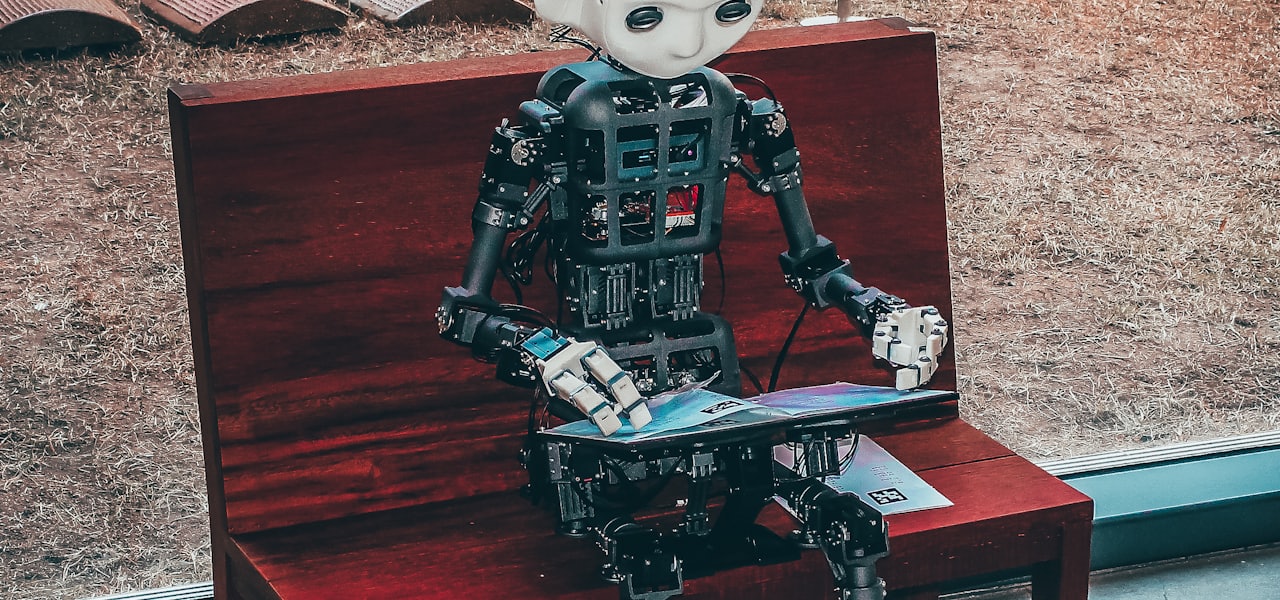
Anthrobotics is the science of developing and studying robots that are either entirely or in some way human-like. The term anthrobotics was originally coined by Mark Rosheim in a paper entitled "Design of An Omnidirectional Arm" presented at the IEEE International Conference on Robotics and Automation, May 13–18, 1990, pp. 2162–2167. Rosheim says he derived the term from "...Anthropomorphic and Robotics to distinguish the new generation of dexterous robots from its simple industrial robot forebears." The word gained wider recognition as a result of its use in the title of Rosheim's subsequent book Robot Evolution: The Development of Anthrobotics, which focussed on facsimiles of human physical and psychological skills and attributes. However, a wider definition of the term anthrobotics has been proposed, in which the meaning is derived from anthropology rather than anthropomorphic. This usage includes robots that respond to input in a human-like fashion, rather than simply mimicking human actions, thus theoretically being able to respond more flexibly or to adapt to unforeseen circumstances. This expanded definition also encompasses robots that are situated in social environments with the ability to respond to those environments appropriately, such as insect robots, robotic pets, and the like. Anthrobotics is now taught at some universities, encouraging students not only to design and build robots for environments beyond current industrial applications, but also to speculate on the future of robotics that are embedded in the world at large, as mobile phones and computers are today. In 2016 philosopher Luis de Miranda created the Anthrobotics Cluster at the University of Edinburgh "a platform of cross-disciplinary research that seeks to investigate some of the biggest questions that will need to be answered" on the relationship between humans, robots and intelligent systems and "a think tank on the social spread of robotics, and also how automation is part of the definition of what humans have always been". to explore the symbiotic relationship between humans and automated protocols.
Unit of work
A unit of work is a behavioral pattern in software development. Martin Fowler has defined it as everything one does during a business transaction which can affect the database. When the unit of work is finished, it will provide everything that needs to be done to change the database as a result of the work. A unit of work encapsulates one or more code repositories[de] and a list of actions to be performed which are necessary for the successful implementation of self-contained and consistent data change. A unit of work is also responsible for handling concurrency issues, and can be used for transactions and stability patterns.[de]
Tabletopia
Tabletopia is an online portal for users to play and create virtual tabletop games. The platform is developed by Tabletopia Inc and initially was released as a web browser based service after a successful crowdfunding campaign in August 2015. In December 2016 Tabletopia was released on Steam, and later in 2018 became available in AppStore and Google Play. == Gameplay == Tabletopia is a sandbox system for running any game. That means no AI or rules enforcement. Participating players will have to know how to play the game. Nevertheless, the platform has some automated actions available, like card-shuffling and dealing, dice-rolling, magnetic placement of components in special zones, hand management, and some others. Tabletopia also features ready game setups for various player numbers to facilitate gameplay. It also has customisable camera controls which let players save camera positions and switch between them using hot keys. People can use the Game Designer mode to design and create their own board games using the component library. They can then monetise the games with a 70/30 split to the game designer. == Development == Tabletopia was created in early 2014, by Tim Bokarev and his partners Artem Zinoviev and Dmitry Sergeev. These co-founders already had experience in the video and board games industry. Their other projects include Promo Interactive, an internet advertising agency, Playtox, a mobile MMORPG, Igrology, a game studio, and Tesera.ru, the main Russian-speaking board gaming portal. By Spring 2014, Artem, Dmitry and Tim created Tabletopia Inc. USA and started development. Tabletopia is a multinational crew that includes professionals from USA, Ukraine, Australia, Ireland, and Germany. The Kickstarter campaign in August 2015 earned $133,721 by 2,545 backers. Tabletopia received Green Light on Steam in September 2015 and was released on Steam in March 2016. The platform remained in Early Access until December 2016, when it was officially released on Steam and on the web. In February 2018 it was released as a stand-alone app for iOS tablets, and in September 2018 for Android tablets.
Digital omnivore
A digital omnivore is a person who uses multiple modalities (devices) to access the Internet and other media content in their daily life. As people increasingly own mobile devices, cross-platform multimedia consumption has continued to shape the digital landscape, both in terms of the type of media content they consume and how they consume it. As of 2021, at least half of all global digital traffic is generated by mobile devices. == Connected devices and digital consumption == A 2015 study of digital media consumption showed that smartphones were primarily used for communication, and tablets were primarily used for entertainment – additionally, both were frequently used in conjuncture with other devices, like televisions. An earlier 2011 analysis of the way consumers in the U.S. viewed news content on their devices throughout the day demonstrated how people use different mobile devices for different functions. On a typical weekend morning, digital omnivores accessed their news using their tablet, favored their computer during the working day, and returned to tablet use in the evening, peaking between the hours of 9pm and midnight. Mobile phones were used for web-browsing throughout the day when users were away from their personal computer. Increased Wi-Fi availability and mobile broadband adoption have changed the way people are going online. In August 2011, more than a third (37.2%) of U.S. digital traffic coming from mobile phones occurred via a Wi-Fi connection while tablets, which traditionally required a Wi-Fi connection to access the Internet, are increasingly driving traffic using mobile broadband access. As of 2021, LTE, 5G, and other forms of mobile broadband access are available on the majority of mobile devices. Tablets contributed nearly 2% of all web browsing traffic in the United States in 2011. During this period, iPads also began to account for a higher share of Internet traffic than iPhones (46.8% vs. 42.6% of all iOS device traffic. == Implications for marketing, advertisers and publishers == As of 2021, the average amount of time spent daily consuming digital media was eight hours, an increase from 2020 and a further increase from 2019, partially as a result of the COVID-19 pandemic. Social media platforms such as Instagram, Facebook, Twitter, and TikTok, as well as other online platforms like YouTube, incorporate advertisements into the in-app or online experience, with some offering the ability to shop for and sell items through the app or website.
Pixel-art scaling algorithms
Pixel art scaling algorithms are graphical filters that attempt to enhance the appearance of hand-drawn 2D pixel art graphics. These algorithms are a form of automatic image enhancement. Pixel art scaling algorithms employ methods significantly different than the common methods of image rescaling, which have the goal of preserving the appearance of images. As pixel art graphics are commonly used at very low resolutions, they employ careful coloring of individual pixels. This results in graphics that rely on a high amount of stylized visual cues to define complex shapes. Several specialized algorithms have been developed to handle re-scaling of such graphics. These specialized algorithms can improve the appearance of pixel-art graphics, but in doing so they introduce changes. Such changes may be undesirable, especially if the goal is to faithfully reproduce the original appearance. Since a typical application of this technology is improving the appearance of fourth-generation and earlier video games on arcade and console emulators, many pixel art scaling algorithms are designed to run in real-time for sufficiently small input images at 60-frames per second. This places constraints on the type of programming techniques that can be used for this sort of real-time processing. Many work only on specific scale factors. 2× is the most common scale factor, while 3×, 4×, 5×, and 6× exist but are less used. == Algorithms == === SAA5050 'Diagonal Smoothing' === The Mullard SAA5050 Teletext character generator chip (1980) used a primitive pixel scaling algorithm to generate higher-resolution characters on the screen from a lower-resolution representation from its internal ROM. Internally, each character shape was defined on a 5 × 9 pixel grid, which was then interpolated by smoothing diagonals to give a 10 × 18 pixel character, with a characteristically angular shape, surrounded to the top and the left by two pixels of blank space. The algorithm only works on monochrome source data, and assumes the source pixels will be logically true or false depending on whether they are 'on' or 'off'. Pixels 'outside the grid pattern' are assumed to be off. The algorithm works as follows: A B C --\ 1 2 D E F --/ 3 4 1 = B | (A & E & !B & !D) 2 = B | (C & E & !B & !F) 3 = E | (!A & !E & B & D) 4 = E | (!C & !E & B & F) Note that this algorithm, like the Eagle algorithm below, has a flaw: If a pattern of 4 pixels in a hollow diamond shape appears, the hollow will be obliterated by the expansion. The SAA5050's internal character ROM carefully avoids ever using this pattern. The degenerate case: becomes: === EPX/Scale2×/AdvMAME2× === Eric's Pixel Expansion (EPX) is an algorithm developed by Eric Johnston at LucasArts around 1992, when porting the SCUMM engine games from the IBM PC (which ran at 320 × 200 × 256 colors) to the early color Macintosh computers, which ran at more or less double that resolution. The algorithm works as follows, expanding P into 4 new pixels based on P's surroundings: 1=P; 2=P; 3=P; 4=P; IF C==A => 1=A IF A==B => 2=B IF D==C => 3=C IF B==D => 4=D IF of A, B, C, D, three or more are identical: 1=2=3=4=P Later implementations of this same algorithm (as AdvMAME2× and Scale2×, developed around 2001) are slightly more efficient but functionally identical: 1=P; 2=P; 3=P; 4=P; IF C==A AND C!=D AND A!=B => 1=A IF A==B AND A!=C AND B!=D => 2=B IF D==C AND D!=B AND C!=A => 3=C IF B==D AND B!=A AND D!=C => 4=D AdvMAME2× is available in DOSBox via the scaler=advmame2x dosbox.conf option. The AdvMAME4×/Scale4× algorithm is just EPX applied twice to get 4× resolution. ==== Scale3×/AdvMAME3× and ScaleFX ==== The AdvMAME3×/Scale3× algorithm (available in DOSBox via the scaler=advmame3x dosbox.conf option) can be thought of as a generalization of EPX to the 3× case. The corner pixels are calculated identically to EPX. 1=E; 2=E; 3=E; 4=E; 5=E; 6=E; 7=E; 8=E; 9=E; IF D==B AND D!=H AND B!=F => 1=D IF (D==B AND D!=H AND B!=F AND E!=C) OR (B==F AND B!=D AND F!=H AND E!=A) => 2=B IF B==F AND B!=D AND F!=H => 3=F IF (H==D AND H!=F AND D!=B AND E!=A) OR (D==B AND D!=H AND B!=F AND E!=G) => 4=D 5=E IF (B==F AND B!=D AND F!=H AND E!=I) OR (F==H AND F!=B AND H!=D AND E!=C) => 6=F IF H==D AND H!=F AND D!=B => 7=D IF (F==H AND F!=B AND H!=D AND E!=G) OR (H==D AND H!=F AND D!=B AND E!=I) => 8=H IF F==H AND F!=B AND H!=D => 9=F There is also a variant improved over Scale3× called ScaleFX, developed by Sp00kyFox, and a version combined with Reverse-AA called ScaleFX-Hybrid. === Eagle === Eagle works as follows: for every in pixel, we will generate 4 out pixels. First, set all 4 to the color of the pixel we are currently scaling (as nearest-neighbor). Next look at the three pixels above, to the left, and diagonally above left: if all three are the same color as each other, set the top left pixel of our output square to that color in preference to the nearest-neighbor color. Work similarly for all four pixels, and then move to the next one. Assume an input matrix of 3 × 3 pixels where the centermost pixel is the pixel to be scaled, and an output matrix of 2 × 2 pixels (i.e., the scaled pixel) first: |Then . . . --\ CC |S T U --\ 1 2 . C . --/ CC |V C W --/ 3 4 . . . |X Y Z | IF V==S==T => 1=S | IF T==U==W => 2=U | IF V==X==Y => 3=X | IF W==Z==Y => 4=Z Thus if we have a single black pixel on a white background it will vanish. This is a bug in the Eagle algorithm but is solved by other algorithms such as EPX, 2xSaI, and HQ2x. === 2×SaI === 2×SaI, short for 2× Scale and Interpolation engine, was inspired by Eagle. It was designed by Derek Liauw Kie Fa, also known as Kreed, primarily for use in console and computer emulators, and it has remained fairly popular in this niche. Many of the most popular emulators, including ZSNES and VisualBoyAdvance, offer this scaling algorithm as a feature. Several slightly different versions of the scaling algorithm are available, and these are often referred to as Super 2×SaI and Super Eagle. The 2xSaI family works on a 4 × 4 matrix of pixels where the pixel marked A below is scaled: I E F J G A B K --\ W X H C D L --/ Y Z M N O P For 16-bit pixels, they use pixel masks which change based on whether the 16-bit pixel format is 565 or 555. The constants colorMask, lowPixelMask, qColorMask, qLowPixelMask, redBlueMask, and greenMask are 16-bit masks. The lower 8 bits are identical in either pixel format. Two interpolation functions are described: INTERPOLATE(uint32 A, UINT32 B). -- linear midpoint of A and B if (A == B) return A; return ( ((A & colorMask) >> 1) + ((B & colorMask) >> 1) + (A & B & lowPixelMask) ); Q_INTERPOLATE(uint32 A, uint32 B, uint32 C, uint32 D) -- bilinear interpolation; A, B, C, and D's average x = ((A & qColorMask) >> 2) + ((B & qColorMask) >> 2) + ((C & qColorMask) >> 2) + ((D & qColorMask) >> 2); y = (A & qLowPixelMask) + (B & qLowPixelMask) + (C & qLowPixelMask) + (D & qLowPixelMask); y = (y >> 2) & qLowPixelMask; return x + y; The algorithm checks A, B, C, and D for a diagonal match such that A==D and B!=C, or the other way around, or if they are both diagonals or if there is no diagonal match. Within these, it checks for three or four identical pixels. Based on these conditions, the algorithm decides whether to use one of A, B, C, or D, or an interpolation among only these four, for each output pixel. The 2xSaI arbitrary scaler can enlarge any image to any resolution and uses bilinear filtering to interpolate pixels. Since Kreed released the source code under the GNU General Public License, it is freely available to anyone wishing to utilize it in a project released under that license. Developers wishing to use it in a non-GPL project would be required to rewrite the algorithm without using any of Kreed's existing code. It is available in DOSBox via scaler=2xsai option. === hqnx family === Maxim Stepin's hq2x, hq3x, and hq4x are for scale factors of 2:1, 3:1, and 4:1 respectively. Each work by comparing the color value of each pixel to those of its eight immediate neighbors, marking the neighbors as close or distant, and using a pre-generated lookup table to find the proper proportion of input pixels' values for each of the 4, 9 or 16 corresponding output pixels. The hq3x family will perfectly smooth any diagonal line whose slope is ±0.5, ±1, or ±2 and which is not anti-aliased in the input; one with any other slope will alternate between two slopes in the output. It will also smooth very tight curves. Unlike 2xSaI, it anti-aliases the output. hqnx was initially created for the Super NES emulator ZSNES. The author of bsnes has released a space-efficient implementation of hq2x to the public domain. A port to shaders, which has comparable quality to the early versions of xBR, is available. Before the port, a shader called "scalehq" has often been confused for hqx. === xBR family === There are 6 filters in this family: xBR , xBRZ, xBR-Hybrid, Super xBR, xBR+3D and Super xBR+3D. xBR ("scale by rules"), cre
Situational application
In computing, a situational application is "good enough" software created for a narrow group of users with a unique set of needs. The application typically (but not always) has a short life span, and is often created within the group where it is used, sometimes by the users themselves. As the requirements of a small team using the application change, the situational application often also continues to evolve to accommodate these changes. Although situational applications are specifically designed to embrace change, significant changes in requirements may lead to an abandonment of the situational application altogether – in some cases it is just easier to develop a new one than to evolve the one in use. == Characteristics == Situational applications are developed fast, easy to use, uncomplicated, and serve a unique set of requirements. They have a narrow focus on a specific business problem, and they are written in a way where if the business problem changes rapidly, so can the situational application. This contrasts with more common enterprise applications, which are designed to address a large set of business problems, require meticulous planning, and impose a sometimes-slow and often-meticulous change process. == Origination == Clay Shirky in his essay entitled "Situated Software" described a type of software that "...is designed for use by a specific social group, rather than for a generic set of "users"." IBM later morphed the term into "situational applications". == Evolution == The successful large-scale implementation of a situational application environment in an organization requires a strategy, mindset, methodology and support structure quite different from traditional application development. This is now evolving as more companies learn how to best leverage the ideas behind situational applications. In addition, the advent of cloud-based application development and deployment platforms makes the implementation of a comprehensive situational application environment much more feasible. == Examples == A structured wiki that can host wiki applications lends itself to creation of situational applications. Some mashups can also be considered situational applications. A forms application such as a Microsoft Access Database (MDB file) can be considered a situational application. The latest implementations of situational application environments include Longjump, Force.com and WorkXpress.